Wednesday, July 25, 2012

Pearls Are a Girl's Best Friend

After a long day of work and our time in Bangladesh slowly running out, a few of my co-interns wanted to go shopping for gifts, keepsakes, and souvenirs.  Having watched a program on Bangladesh right before I came here (thank you for recording, Grandma) I had a deep desire to purchase Bangladeshi pearls. I have never bought nice jewelry for myself, so I had no idea where to begin guessing the price. My only reference was a $200 pair of Tiffany pearl earrings a dear friend from college owns.

My friends conceded to hit the pearl market before going to Aarong (the clothing and handicrafts store), and they have me to thank. We proceeded to spend an hour and half digging through all the pearl jewelry in the market. Because of the odd shapes and sizes, we knew these pearls were authentic; their imperfections made them even more alluring. When I found a pair of classic white pearl earrings, I asked, “How much?” Upon hearing “100 taka,” I stared, dumfounded, into the salesman's eyes. That’s about $1.25 for a pair of real pearl earrings. Now you’re probably thinking, "Poor Carmen is so naïve. She just got completely ripped off." The truth is, pearls are so abundant in Bangladesh that they cannot sell them for exorbitant prices. Also, the metal they use for the pendants, brooches, rings, bracelets and earrings is extremely cheap, giving the final product less value. But, when you’re an American girl faced with real pearl earrings for $1.25, it’s hard to fuss about silver quality. In fact, I even bargained for a lesser price. Shameless, I know.

Five of us interns celebrated our retail victory over Indian food. The salesmen also seemed pleased as we left, hoping we would tell our friends about our newfound treasures but not about how much we paid. I have to admit, until this experience, I had never really enjoyed shopping for fine jewelry. As someone with more colorful, whimsical fashion tastes, I have not grown into the elegance and simplicity of showcase jewelry. However, this experience was incredible! Maybe it was the affordability that made it more fun. Who knew that I would find a love for jewelry shopping in Bangladesh. One thing is for sure, I will never be able to buy pearls anywhere else in my life.


Monday, July 23, 2012

Final Days in Nepal


Mountain views on the ride to Pokhara

Day three in Nepal, we woke up at 6:00 am to catch a 7:00 am bus to Pokhara. The 7-hour bus ride, traversing through the mountains, landed us in the quaint lake town. The town had  a much different vibe than Kathmandu. Although both touristy and kitchy, it was much quieter and relaxing. Once we dropped our things off at a hostel, we found a restaurant which overlooked Lake Pokhara. The one we chose had a Greek Island/Mediterranean theme, as the tables and chairs were painted white and dressed with blue cushions and napkins. After a 36 hour whirlwind in Kathmandu, we sunk deeply into our seats and absorbed the tranquil scenery surrounding us.

After dinner, we made our way out to the lake and walked around a bit. At least 50 rowboats floated in the water, awaiting passengers to ferry across the lake. We stared into the majestic blue sky and eerily still lake, planning our adventures for the following day. On the way back from the lake, we stumbled upon one of many spas in Pokhara, and decided to get impromptu massages; it’s hard to turn down a 45-minute massage for $6.

Boats on Lake Pokhara
The next morning, we woke up to pouring rain. Although absolutely soaked, we did manage to find Pokhara’s famous organic coffee house. We giggled at our über relaxed waiter over Himalayan plunger coffees and chai teas served in mugs resembling large beer mugs. His totally relaxed demeanor sent us over the edge as we observed him tossing menus to customers nonchalantly and reluctantly dragging himself into the kitchen to relay orders and prepare drinks. We waited the rain out by shopping around, realizing that established tourism also means higher price expectations, despite one’s ability to bargain.

The itty bitty white temple you see at the top
of this picture is the Peace Pagoda.
Finally, the sun came out and we embarked on our hiking adventure up to the Peace Pagoda (temple). When I first saw the Peace Pagoda, triumphantly standing on top of the mountain across the lake, I was shocked to hear the hike takes about 45 minutes; we expected a day-long expedition. We started the journey with a calming boat ride across the lake. Then we began the grueling expedition up the mountain. Although shaded by a forest, the morning rain had dissipated all cloud coverage. We sweated profusely and finished all of our waters before we finally reached the Peace Pagoda.

The white and gold structure was absolutely stunning on the mountain top. Around the temple were carvings depicting the Buddha’s history and captions describing each scene. As I read about the Buddha’s progression toward the meaning of life and inner peace, I could not help but feel like I was on the same journey on top of this mountain. Looking down at Pokhara, it was hard not to think about life’s greater purpose. As for the history of the Peace Pagoda, after WWII, particularly the bombings of Hiroshima and Nagasaki, a Japanese Buddhist monk decided to erect Peace Pagodas across the world in order to unite people under the same goal of promoting peace and non-violence. Today, there are over 80 Peace Pagodas in the world.
View from the hike

Peace Pagoda
Before hiking down, we stopped at a nearby café and admired the view for another hour while indulging in the most flavorful momos of the trip. On our hike down, we hoped to find a waterfall called Devil’s Falls, but unclear trail markers caused us to find the main road before the waterfall. We hopped on a local bus and made our way back to our hostel to shower up and prepare for dinner. On the way to the restaurant, we decided another $6 massage wouldn’t hurt after a grueling day of exercise. So, we treated our bodies before returning to the Mediterranean oasis restaurant. As my last meal in Pokhara, I was sure to load up on fresh vegetables, a rare treat in Dhaka.

In the morning, we caught a 8:45 am local flight to Kathmandu. Within 25 minutes, we were back in the city. Having received an email from Biman airlines that our flight would be delayed until 3:40 pm, we headed out into Themal, Kathmandu to do some more shopping and eat one last fresh meal. We stopped at the hostel where we had previously stayed, and the friendly staff graciously stowed our bags for a couple hours while we paraded down the streets of Themal, bargaining our brains out until we had completed our shopping lists. As our last supper, we ate at a famous pizza restaurant called Fire and Ice. It did not compare to my local Minneapolis favorite, Punch Pizza, but it was the best pizza I had had in Asia thus far.
I was so sweaty, but it was worth this nice view of Pokhara.

When we got to the airport, we were not surprised to find that Biman had further delayed our flight. Coincidentally, we ran into a man we had met on our way to Nepal four days prior. This Bangladeshi man, I learned, attends the University of Minnesota! Running into a Minnesotan is always special, especially halfway across the world. Between his charming personality and ability to speak Bangla, we passed the time sharing stories from our trips and keeping tabs on the flight status.

By the time we boarded the plane, I noticed my seat number was 2A. How I ended up in first class, I do not know, but I enjoyed every bite of my complimentary mixed vegetables and chicken curry. I even had a private viewing of Mount Everest out my window as the crew fended off the eager coach passengers trying to get a view from first class. An up-close view of the Mount Everest peak ended my Nepal vacation on a perfect note.   

Mount Everest!

Wednesday, July 18, 2012

Tour de Kathmandu

The fresh air in Nepal makes a perfect location for rooftop terraces and balconies. For breakfast, we picked out a lovely restaurant called Helena's. We climbed up eight floors to find the best restaurant view in Themal. With mountain views from every angle, we enjoyed yak yogurt with fruit, pancakes, french toast, and my first Nepali tea, a hearty meal for a busy day of touring. 

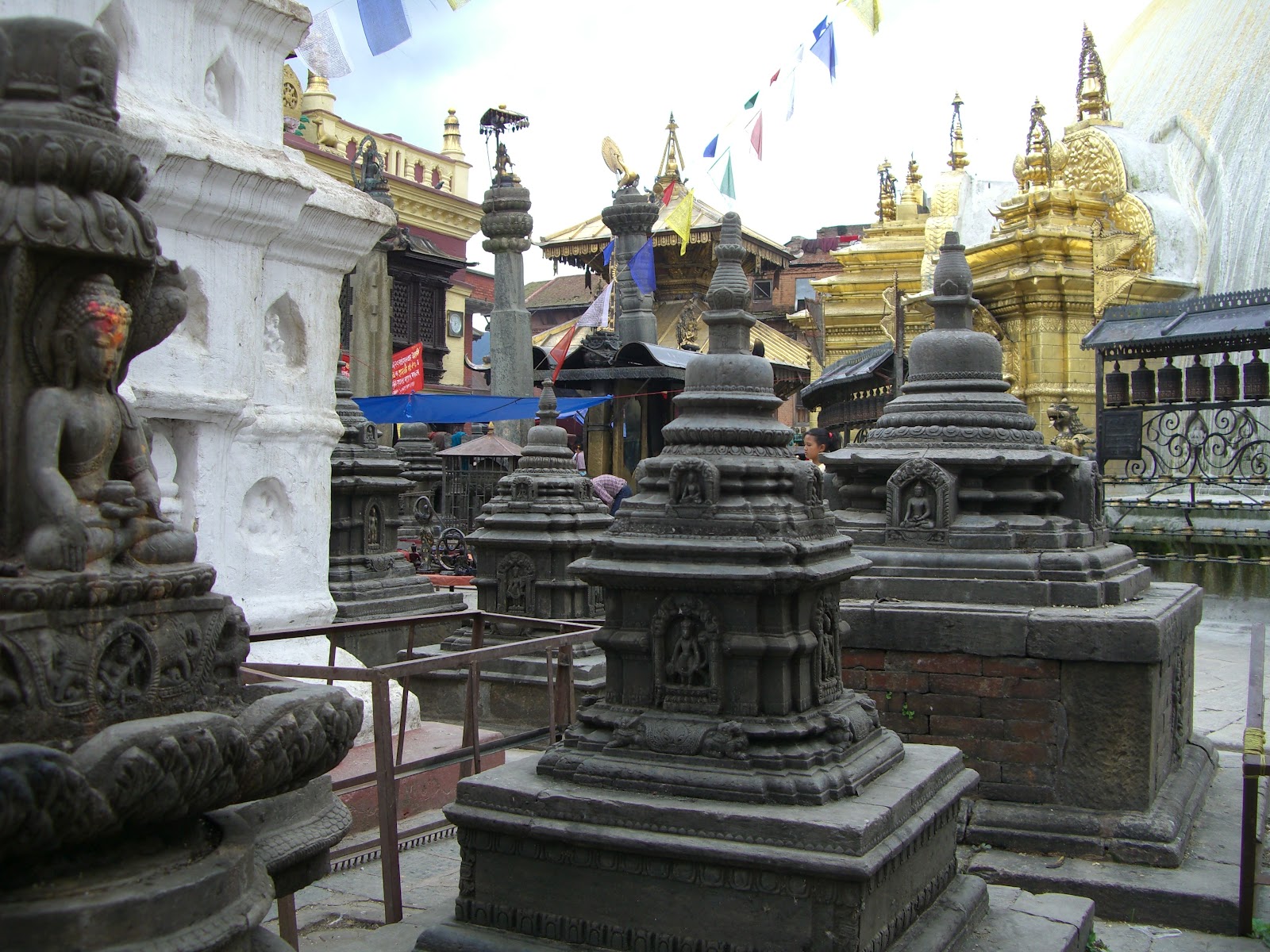
We first stopped at Sayambounath, also known as the Monkey Temple. Nothing could have been more fun than seeing heaps of monkeys and their babies crawling, jumping and swimming all around. I was so enamored by the wild monkeys, I was reluctant to leave and see the rest of the temple. Nevertheless, I proceeded up the stairs to find numerous vendors, temples, and small children trying to pickpocket us. Once in a while, a monkey would come out from behind a temple or crawl down from a tree - such an amazing sight to see, not to mention the mountain views. We stopped at a second Buddhist temple that, in my eyes, did not compare with the Monkey Temple. 
Such cute monkeys! Can you see the resemblance? 
So many Buddhist sculptures at the Monkey Temple 

Kathmandu
View of the Old City from the rooftop restaurant. The tall
building on the right is the tallest temple in Nepal.
Our next stop was Bhakdapur, the Old City in Kathmandu. We stopped for another roof top meal to be surrounded by mountain views yet again. As always, we ordered plentiful momos (basically pot stickers). I of course stuck as close to local cuisine as I could. When finished, we ventured into the Old City and toured the stunning buildings. Some of them were over 2,000 years old. Many were too old to tour inside, but there were others in which people actually lived. The most stunning was the tallest temple in Nepal partly because of its height and partly because of the large statues lining the steep stair case up to the entrance.

This is actually an imitation of a scene in a Bollywood film called Lagaan.
One of the few serious pictures we took.


Our last stop of the day became an exciting race against the sun. Having spent much longer than expected admiring the Old City, our driver had to punch the gas in order to get us to our stunning sunset view in the mountains. As we traversed uphill and through clouds, I felt like I was back in Colorado, except without guard rails. When we finally reached 21000 feet, we had reached our viewing point. There, monumentally standing in front of us was Mount Everest. The drama of this moment caused me travel in time a bit, back in elementary school when I first heard of the Himalayan Mountains. They were so exotic and so far away, and now, probably 10 years later, I was standing in front of them, eyeing the peak that humans vie to defy. In a way, Mount Everest represents a standard of invincibility, and here I was, little me looking right at it. I thought of the Bangladeshi girls who returned from climbing Mount Everest shortly after my arrival in Dhaka. What an amazing feat.

My one successful
airborne shot.
Of course we took a million different pictures on the mountain together. Everything from jumping, serious, and silly pictures; we had a small-scale photo shoot in front of Mount Everest. Once the sun set, local vendors at the viewing point sold us beer and made us Himalayan coffee. Even though coffee is one of my favorite smells in the world, I absolutely hate coffee, but when traveling, I am an in-the-moment person and decided that I had to try Himalayan coffee brewed right in the area where it grows. The glass of Himalayan coffee I drank was absolutely fantastic. It may have converted me to becoming a coffee drinker.

Once the sun set, our driver carefully returned us to our hostel, artfully navigating his way down the unlit roads lining the mountainside. Completely exhausted, we quickly fell asleep yet anxious for our next adventure. To be continued...

Tourism


At the crack of dawn, I was awoken by my concerned Bengali girlfriend. Using my newly developed Resident Assistant repertoire, I reassured her that our $2.50 per night hostel would be plenty safe, and if it turned out to be dirty, we would move. Her housekeepers set the table with beautiful bowls and plates for us to eat basic breakfast food like milk, cereal, toast, jelly, and peanut butter. Maybe this gesture was out of hospitality for me, their guest, but as a college student, I have become accustomed to plastic bowls and paper cups. Their effort was more than generous.


We managed to make it to the airport with an hour and a half to spare. Per usual, Bangladesh has no formal organization so the airport was absolute chaos. Without organized lines behind the ticket counters, we shoved our way to the front of the line just to find out that we needed to line up at a counter on the other side. Frustratingly, the airport accounts for Bangladesh’s general disorder and allowed all the passengers for the flight to Rome, leaving in 30 minutes, to move to the front of the lines. Four ticket counters and an hour later, we made it through security only to find our flight was delayed two hours: disappointing to wake up at 5:30 am for nothing. A couple minutes later, we noticed that our flight was delayed by another two hours. Moments later, the flight disappeared from the monitor.

We quickly sought a Biman Airlines representative who unhelpfully directed us to the airport café “Spices.” After hours of waiting, my Bangladeshi friend, with my full support, raged at the Biman Airlines crew member who spoke of the all too familiar “technical problem.” It took us six hours to finally depart for Kathmandu, Nepal. We essentially lost a day of touring. Normally, I am fine with a delayed flight. What made this situation so miserable was the lack of communication between the airline and its passengers. I would like to think it was a language barrier, but I traveled with a native speaker who was just as frustrated as our British and Australian comrades. They had experienced the same lack of communication in the Dhaka passport office where they obtained their multiple entry/exit visas. This quality even exists in BRAC, where there is no central database where each department of the organization can access common files and information. To collect information for my video project, I had to run around offices within and outside of BRAC. Communication is not one of Bangladesh’s strengths, which probably contributes to its lack of tourism. 

The busy city street. Had I come here before traveling to Dhaka, I would have found this
street overly populated and grimy, but instead I found it energetic and inviting.
A short, one hour flight landed us four ladies in Kathmandu, Nepal. The moderate climate and breathtaking mountains had us jumping in our seats. We couldn’t wait to explore the big city situated in a valley surrounded by the highest mountains in the world. When we exited the airport, we were bombarded by sleazy cab drivers, begging us to pay exorbitant prices for service to our hotel. I was intimidated by all the fluent English-speaking, smooth talkers. Suddenly, it became very clear that we had entered a tourist friendly destination. Having lived in Dhaka for five weeks now, I felt overwhelmed and uncomfortable being bombarded with business cards, cheap jewelry, and tacky souvenirs. On the flip side, I was enamored by the vibrant streets, lined with colorful shops and people from all over the world.

When we arrived at our hostel, we were impressed by the hospitality of the staff and their eagerness to help us organize an itinerary for the next day. We were not so impressed by the modest accommodations and filthy bathroom. Although the sink spat out brown water, the shower miraculously had warm water. We planned to spend all day on the town anyway, so we sufficed.

Our adventure began exploring the streets of Themal, Kathmandu, the tourist hub of the city. Shopkeepers beckoned us to enter their stores. After a while, we realized most stores sold the same products. Among the heaps of mementos, I managed to find some goodies. Of course, I never paid full price for anything, bargaining my way down to nearly fifty percent of the asking price.


A glimpse inside a temple in the middle of the busy Themal streets.
Chanting monks joined us shortly after this photo was taken.

Fresh fruit juice stand - a novelty when coming from Dhaka.


Momos quickly became our favorite snack in Nepal. They
are basically a pot sticker, but they taste much fresher,
especially at an organic-food restaurant!
Once the stores closed, we suited up in our new apparel and made our way to a lovely little place called “Organic Green Restaurant and Farmers Bar.” One major challenge in Dhaka is eating quality food. While the city has hundreds of restaurants, people are safest eating warm, cooked foods. Fresh produce is often contaminated with pesticides and preservatives harmful to human health. Adventure sports like trekking, bungee jumping, and hang gliding attract outdoorsy tourists. For those of you that do not know, Mount Everest is actually located in Nepal. Naturally, Kathmandu has loads of organic, fresh foods, and we took advantage of this treat. We also took advantage of the predominantly Hindu and Buddhist religions in Nepal and ordered rum punches. The food was absolutely delicious. I even grew a liking for yak products like yak cheese, yak milk, and yak butter.

On the walk home, the girls spotted a shisha (hooka) bar, where we spent the next couple hours relaxing. While I refused to smoke tobacco, I thoroughly enjoyed taking in the starkly different culture surrounding me. To think that just hours ago, I had been in a country where I cannot bare my shoulders and knees, where I am an overwhelming minority, where I can hardly communicate with local people, where alcohol is sold exclusively in a few licensed restaurants and bars. My head was in the clouds as I watched young women in skin tight skirts and tank tops crawl over the low lying tables to order drinks from the bar. I had not seen people take shots since the “No Regrets” party after final exams at college. I felt refreshed, but I could place what exactly caused this feeling of relief. As the third developing country I have visited, I was amazed that I felt safe walking the streets at night and quite welcome. Certainly in Dhaka and Tijuana, one has to take great precautions. By the end of the night, I understood something that I had never really understood before: tourism.

I had known the dictionary definition of tourism, but now I have lived in somewhere without any such industry and visited an even poorer country with an incredibly developed tourism industry. My understanding of this concept has become three-dimensional. A couple of my travel mates were shocked to learn that Nepal is in fact poorer than Bangladesh. Like in Mexico, tourism in Nepal shields visitors from its stark realities. On the other hand, poverty is inescapable in Bangladesh. It is one of the most vivid realities for visitors. Less beggars, less decrepit persons, and loads of tourists left me awe-struck but also aware of the sheath I had discovered. To be continued...

Four happy travelers!


Unrelated announcement: My partner and I won BRAC's Facebook video campaign competition! It has been announced on BRAC's Facebook so you should check it out. Thank you so much for those who voted. 

Thursday, July 12, 2012

Parental Control


Tomorrow, I depart for a trip unlike any trip I have ever taken before. I am traveling with a Brit, Aussie, and Bangladeshi girl – a multicultural group! Even though we haven’t even taken off for the trip yet, I feel like the adventure has already begun. Not only do we have to compromise among our personal interests, but we have to compromise among our cultural differences. It probably does not come as a surprise that the Brit, Aussie, and myself have a fairly easy time striking a middle ground. Planning our travels with my Bangladeshi friend has taught me a lot about how kids grow up here and their loyalties.

This morning, when finalizing travel plans, I thought back to my post from last night had a realization. I neglected to analyze the ubiquitous presence of parents in their children’s lives in Bollywood cinema. The parents in Dilwale  Dulhania Le Jayenge had immense control over their daughter’s life. Every decision she made in life had to be approved by her parents, particularly her father. Rarely do American romantic comedies include parental roles. Certainly there are exceptions, but on the whole, the success of “true love” comes down to two peoples’ decisions. In Bollywood, this is a family affair.

When I bought my ticket for Kathmandu, Nepal, a couple of my Bangladeshi friends laughed about how their mothers prohibited them from traveling there or how their fathers wished they could send body guards with them. When they asked me what my parents thought about my travel plans, I proudly admitted that I had not told my parents yet. They looked at each other in utter dismay. I explained that when I told my parents, they wouldn’t mind and would support my thirst to travel. In fact, they may even want to join me for a weekend at the foot of the Himalayan Mountains if possible (anyone would be crazy not to). I went so far to say, “When I ask my parents for advice, they usually tell me ‘Carmen, you are 21. You can make your own decisions without my approval, and I will support you in whatever you decide.’”

Sometimes, this responsibility can be tiring. It would have been much easier to get denied from all the colleges I applied to so that I would not have had to make a decision. There were a few times this year when I wished my parents, a friend, or a professor could make a decision for me so that I would not have to fret about making the wrong choice myself. Listening to my friends talk about their relationship with their parents, I have become very thankful for my independence. I have 100 percent control over my destiny because my family and culture allow me to. I think back to these desperate times when I have wanted others to decide for me, and I know I will never be able to think like this again.

Wednesday, July 11, 2012

Pop Culture

First order of business: the BRAC Interns are having a competition of the best video project. The videos are posted on Facebook, and we need votes! Follow the link below, like the BRAC page, then you can vote: https://www.facebook.com/BRACWorld?v=app_202991206406825&rest=1
The videos are really fun to watch. Although I hope you will vote for mine, the others are really good, and tell great stories about some of BRAC's amazing programs!

Now, back to my cultural insights:

Getting into a different cultural mindset has been one of my greatest challenges in Bangladesh. Learning about Bangladeshi culture from experience can be painfully difficult at times, so I have really enjoyed studying Bangladeshi pop culture through literature and cinema. Yesterday, I bought a three Bollywood films for 100 taka each, and today I had the chance to watch Dilwale Dulhania Le Jayenge. If I had to guess, most Americans have not heard of this film. When I learned of its immense success in India, I was shocked by my ignorance. This film, released in 1995, is the longest running in Indian cinema; it still plays in a theater in Mumbai.

"Dilwale dulhania le jayenge" does not translate precisely in English, but it basically means "the one with the brave heart will take the bride." The Bangladeshi and Indian girls in the office talked the movie up so much. They said I had had had to watch it because of its heartwarming plot and entertainment value. While I so enjoyed the frequent song and dance numbers and the extreme drama, it did not quite reach my expectations. Don't get me wrong, I would give it 3.5 or 4 out of 5 stars, but the archetypal romantic comedy plot simply was not captivating. On one hand, I had seen this movie a million times, but on another, I had never seen anything like it.

A country of nearly 1.25 billion people worships this three hour long film, yet it has little recognition in the United States. What's wrong with this picture? Culture and the comforts of home have a huge influence on the media we enjoy. I noticed this when I discussed the book Brick Lane with one of the Bangladeshi interns. I just finished this book last weekend. The novel had a powerful message, however the text was slow, and I found myself trudging though the last 100 pages. On the contrary, Brick Lane completely enticed my friend because it is a Bangladeshi novel written by an English-born, Bangladeshi woman. She understood the reality of this novel and likely found parallels in her life, whereas I remained in denial that ultra-conservative Muslim women live in captivity. Then I remembered how I felt when I watched Bridesmaids for the first time two weeks ago. At a low point in my homesickness, seeing American cinema, American humor, American actresses, and a Christian wedding, I remembered my home and how great it will be when I arrive there again. There's no way that my Bangladeshi friends have the same appreciation for this film that I do. I live the life depicted in this film (not strictly speaking of course), and they can only appreciate this film as outsiders.

When another Bangladeshi intern commented that Dilwale Dulhania Le Jayenge is a far better film than When Harry Met Sally, I almost accused her of perjury. But, I stopped myself, remembering the different worlds we come from. I have had the chance to talk with the Bangladeshi interns about their love lives and what role their families, religion, and culture have played in seeking love. I find it ironic that parents in the United States view young love as immature and preliminary. High school sweethearts rarely follow each other to college because of parents encouraging independent decision-making. In Bangladesh, parents seem to take young love very seriously, and openly anticipate wedding plans, sometimes even pressuring young adults into committed relationships. Many of my girlfriends at BRAC have already felt this pressure. Dilwale Dulhania Le Jayenge is their reality; to some extent, this film depicts the lives they live. Instead of dismissing Dilwale Dulhania Le Jayenge as just another romantic comedy, my experience in Bangladesh allows me to appreciate how well the movie captures the multidimensional challenges of marriage in the Indian Subcontinent. 

Monday, July 9, 2012

OH. MY. GOSH.

After a little over a month of being cooped up in Dhaka, a group of four other interns and myself needed an escape. Per the advice of a fellow CMC-er, we ventured to Srimangal, a small town about 240 km northeast of Dhaka. Srimangal also happens to be the tea capital of Bangladesh. While planning this trip, I joked with my friends that this trip would be "the best weekend ever." In an attempt to avoid jinxing our get-away, the phrase did not catch on and we humbly proceeded with preparing for the long weekend. Since making it home unscathed, I can say that this weekend could quite possibly have been the best weekend I have ever lived.


The trip began with a 12:32 train ride at the Airport Railway Station. One of my friends had made friends with an German-born, Turkish expat the night before our trip, and after hearing our weekend plans, he cancelled his business meeting to join us. His indifference for cultural barriers and charisma initially shocked me, yet made me more confident in standing up for myself in this foreign country. Of course a huddle of six fair-skinned individuals beckoned a crowd of curious Bangladeshis and begging children. Our Turkish friend assertively hissed at the beggars. When they held out their hands, he shook their hands, joking with them. If they touched him, he picked them up, turned them around, and gave them a light spanking. Needless to say, I strove to keep my jaw from hitting the floor.


Our inhibition-less Turk made friends with a local Bangladeshi who had seats near ours and helped us navigate the frantic scene that pervaded the platform once the train arrived. Upon entering the train, we were pleasantly surprised at the accommodations which the Bangladeshi interns had warned us about. The cushioned seats, fans, and open windows made for an absolutely delightful ride. To explain the title of this blog post, these were the first words that came to mind when the train exited the outskirts of Bangladesh. From the moment we left Dhaka, the scenery left me speechless.
Could this be Lake Minnetonka? Maybe without the palm trees. The majority of the scenery actually reminded me a
lot of the rather flat Midwest terrain. Close to shore, you can see kids swimming. During the uncomfortably humid monsoon season, kids often keep cool by playing games in the 24,000 km of inland waterways. 
To prepare for the weekend, I gladly
accepted a cup of tea during the train 
ride. At a rate of 6 taka (about 7 cents),
this cheap treat of black tea and condensed 
milk hit the spot. Just above my cup of tea 
captures the ever-present intrigue of the 
local people. No, he's not sleeping.


When we arrived in Srimangal, I was delighted to only hear the jingling of rickshaw and bicycle bells. In Dhaka, a period of five seconds without a beeping automobile is infrequent. Within moments of hopping on rickshaws, the quaint town turned into waves of tea bushes, hills of pineapple plants, and  miles of serenity.


While our intern coordinator encouraged us not to travel to the tea estate region because of the flooding in Sylhet (the big city about 90 km away) and our Bangladeshi peers urged us not to take the train unless we scored a first class air conditioned berth, we did take the advice of one of the Bangladeshi interns who recommended staying in the Nishorgo Eco-Cottages. What a cool place. The cottages were erected as part of a USAID project to help promote income from tourism in the Srimangal area. If you know anyone planning to travel to Srimangal, they must stay in the eco- cottages. While they neither have air conditioning nor warm water, the powerful fans and hot weather make these accommodations unnecessary luxuries. Having arrived at about 6:00 pm, we spent the evening exploring the area around the cottages and indulging in our dreamy balcony, where we could actually hear the sounds of nature. With a deep breath of fresh air, I enjoyed my first pollution-free inhalation since May. 

Eco-Cottage


At 8:30 am the following morning, we ate a classic Bangladeshi breakfast of paratha, chili filled omelets, mixed vegetables, mini bananas, and tea. Our first destination was the Lawachara Forest, one of Bangladesh's National Parks. The hike through the jungle-like forest was stunning. Filled with tall trees, critters, and villages,  I had never seen anything like it. A guide led us through the dense trees until suddenly, we reached a pass of small lime trees and mud homes. Its inhabitants were exceedingly friendly and followed us as we hiked through the hills. When we reached one of the homes, we saw they had harvested a number of limes. The family gladly gave us a half dozen limes, but when we pooled our smallest change together, they refused to accept it. Having spent a fair share of my time being swarmed by beggars, a sense of marvel fell upon me. 


I finally met some of my kind: monkeys! The monkeys
pictured are likely a species of gibbon.
A few weeks ago, when I went on BRAC field visits outside of Dhaka, I understood why people fled to city-life in Dhaka. Standing on top of a tall hill surrounded by a the lush Lawachara Forest, I suddenly became confused. When people move to the city, their purpose must be to make money to bring back to their families. The families that stay out in Srimangal, take in the beauty, and live humbly in their mud homes do not have this same urgency. They may make money selling limes to the village, they may not make any money, but they live peacefully together and enjoy their lives spent with one another. This made me question my purpose in life. Most of the kids I work with, including myself, have aspirations to alleviate poverty, feed the world, and eradicate diseases. In the process, some of us hope to make enough money to travel and achieve a high standard of living for our families. Although I was overjoyed to meet poor Bangladeshi people who did not want to take advantage of our relative affluence, it made me think twice about how I want to live. Do I want to be one of these people who lives to love my family and friends or will I compromise my time with achieving ideals and intangible dreams? Another year of college is not enough time to answer that question, even a lifetime. What I can say is that I hope I can live as humbly and kindly as these fiscally unfortunate because in my mind they are much more fortunate than the relatively well-off rickshaw wallah's and beggars in Dhaka city.  
View from the top of a hill in the midst of the lime farm. The flock of white birds had just taken flight, as if they knew how to make this scene even more beautiful. As you can see, this makes for a great place to contemplate the great wonders of life.
The woman sang to us from her hymn
book. We enjoyed the lovely view out
her back door: a 15-foot drop to the
ground and miles of tall trees.
When we reentered the jungle, our guide took us to a Christian village where a friendly woman hosted us. She gave us bettle-nut, a small red nut that one wraps in a leaf and chews to achieve a buzz similar to that of chewing tobacco. Many Bangladeshis chew it quite openly. The nut turns chewers' mouths blood red, creating a somewhat terrifying image. In this village, the society was somewhat matriarchal. Instead of women leaving their homes to live with men, the men moved in with the women. The woman we spoke with had four children, two boys and two girls, studying and working both inside and outside of Bangladesh. The woman spoke an unfamiliar dialect of Bangla. She showed us her Bibles which were translated into this language. She even sang us Silent Night from her hymn book and in her native language. We returned the tune in our native English 
tongue. 

Seven-layer tea! We counted.
At the end of the tour, we headed to our next stop: the Nilkantha Tea House. Here, the famous seven-layer tea was invented. Layers of cinnamon, sugar, lemon, milk, and three other mystery flavors entertained our taste buds. Followed by a short lunch, our drivers miscommunicated and our group split. Half headed to a Burmese village to collect locally made rice wine. The other half headed straight to our final destination: a tea estate which housed a breathtaking lake. We tried to conquer the circumference of the lake, but sunset prevented us from safely navigating the shoreline. Instead, we turned around in time to snap pictures of the sunset and befriend the vendors at the estate entrance. Because of the tall buildings, pollution, and monsoon clouds, this was the first sunset we had all seen in Bangladesh. Ironically, the red dot on the Bangladesh flag, pictured in the background of my blog, represents the sun. We had no trouble resting our eyes on the glowing sky as it melted behind the hills. We enjoyed the last moments of sunlight learning Bangla phrases and numbers with Bangladeshi children while enjoying the cha (tea) their parents had made for us.


Sunset on the lake.
On our last day, the group split again. Two went to the village to shop while the rest of us traveled to more tea estates. We had been warned that it can be difficult to access tea estates without connections, but we decided to take our chances. Our first stop was the Bangladesh Tea Research Institute (BTRI). We walked down a straight path for what felt like a heavenly eternity. We turned into the BTRI Resort and sipped down a splendid cup of cha in air conditioning. Across the street, we tried to gain access to the estates, but the young guard would not let us enter. We continued down the endless path, admiring the charming homes, people, and animals. After a few kilometers, we saw a BRAC sign on a thatch hut and had to investigate. Around 20 kids stuck their heads out of the windows and enthusiastically greeted us. I promptly asked their names and explained that we worked for BRAC. They invited us into their classroom. Since the teacher was away on a short break, the kids looked to us for direction. A few girls in the class took initiative led a song to which the entire class sang and clapped along. Two girls danced, giving us a great show. When the teacher arrived, we thanked her and the students for their hospitality and left them to continue their learning. 
Impromptu visit to a BRAC School

As we left the village, young children ran after us waving and yelling "bye-bye." They seemed to use the phrase "bye-bye" as both a greeting and departing expression. Their earnest jubilation kept me smiling throughout the rest of our BTRI exploration. 


Our final stop happened to be my favorite stop of the entire trip: the Zareen Tea Estate. Here, the Ispahani Tea is grown, one of the most widely purchased teas in Bangladesh. The Lonely Planet Guide recommended visiting this tea estate, as it usually welcomes tourists. We sought the garden manager to ask permission to enter the estate. The empty office and friendly men working in the tea processing station spurred us to enter the estate. Shortly after entry, we met a man who was the uncle of a man who lived and worked on the estate. He beckoned his nephew to tour us around Zareen Tea Estate. At first glimpse of the nephew, I had found my purpose in life: to marry this adorable man and co-own a tea estate. Just kidding, but he was really cute and seeing the Zareen Tea Estate was one of the most incredible experiences of my life. Miles and miles of tea bushes wrapped around the hills. I wondered if this is where Dr. Seuss gained his inspiration. 


Our rather handsome tour guide leading us
through the steep, narrow paths between the
tea bushes. The pickers, likely barefoot, scale
these steep hills on the regular.
For a clearer picture of the tea industry in Bangladesh, the estates today are owned by Bangladesh elites or the government. When I asked our guide if he would like to own an estate one day, he said he was not qualified. Although pursuing a business education at the local college in Srimangal, he is not qualified probably because he is not in line to inherit an estate nor a member of the Bangladeshi government. Tea leaves must be handpicked; there is not mechanized method of harvest. Highly skilled workers, predominantly women, pick the bright green leaves which come in a set of three. The workers make 48 taka per day on this estate (almost 60 cents). 


If we didn’t have to catch our train that evening, I could have hiked through Zareen Tea Estate all day, all week, maybe even an eternity. During the tour, I was speechless. All I could say was, “Wow, this is beautiful. I can’t even explain how beautiful this is.” None of us wanted to return to Dhaka. We joked about disappearing in the tea bushes and cutting off our city contacts. We reluctantly packed up our eco-cottage and endured the 5 hour train ride back to Dhaka. Clearly in denial that the best weekend ever had ended, we missed our train stop and took a terrifying CNG ride from Old Dhaka to our places. Our driver last night was the craziest driver I have had in Dhaka. Normally vehicles follow the big shark little shark rules of the road, but this guy had no regard for trucks or cars. Speeding through small alleys, we soared over potholes, almost capsizing. At one point, I banged on the barrier between the driver and passengers, wailing to be let out. He thought this meant go straight (the direction I had been trying to tell him to go), so we finally headed the right direction down Gulshan Avenue. Funny how language barriers work. This rude awakening certified that I was back in Dhaka.
Striking a pose on the rickshaw while our drivers were M.I.A.
 Universal Studios should have cast me as E.T.


The weekend in Srimangal showed me a world I did not know existed. I fell in love with an enchanting place of serenity, solitude, and overwhelming beauty. After countless cups of to-die-for tea, one of the interns and me abused the phrase "cha koob moja cheelo" meaning "the tea is very delicious." This morning I learned that this phrase can also mean "very fun" or "very funny" depending on the context. Maybe I can even say "Srimangal koob moja cheelo." Before this weekend, I was not sure if I would ever visit Bangladesh again. Now I know that I cannot die before visiting Srimangal again.